On Flagging
What's the deal with all those flags?

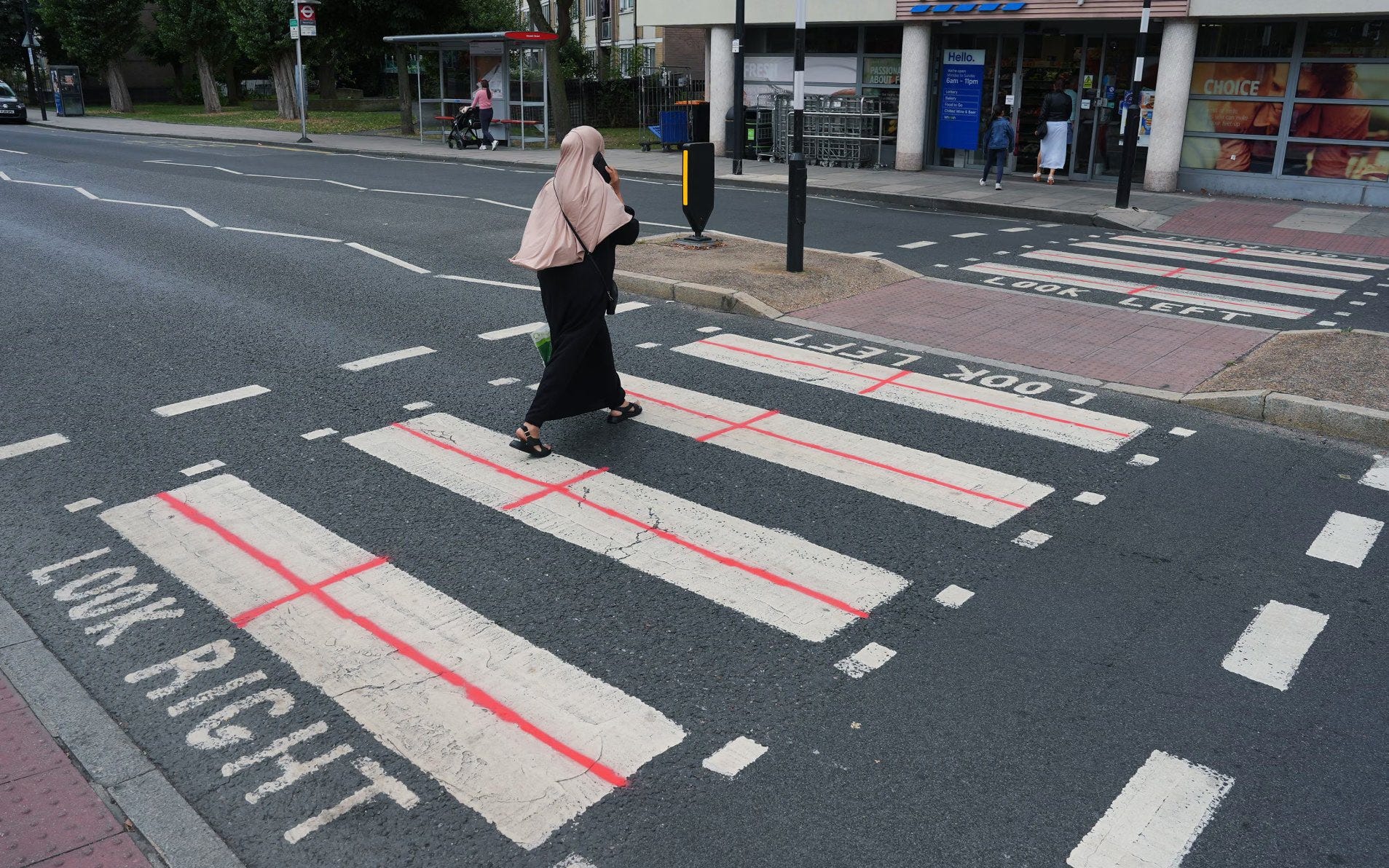
Flags have been in the news a lot lately. Across the country, the Union Jack and the Cross of St. George have appeared zip tied to lamp posts and spray painted on any white surface patriotic vandals can find, for reasons everybody implicitly understands yet very few people have been able to articulate in clear terms. This is no doubt because of the often ambiguous and varying meaning that flags are able to conjure up as abstract symbolism which often defies clear explanation, and the muddled and obfuscated place the identities represented by these flags are in at present.
As far as I can tell, this campaign originated in the south of Birmingham. Last weekend, I saw this with my own eyes. Visiting a friend in Longbridge, I saw the dual combo of English and British flags tied to every bridge heralding the approach to Birmingham on the M5, and saw lampposts adorned alternatively with each flag on various streets around the south-west parts of Birmingham. This was quite a shock to me. Although I was aware of this campaign, I had assumed it was limited to the odd boomerish Facebook video or two shared around some of the lower quality parts of the right-wing internet. Evidently not so. The freakish political parts of the web I must admit I sometimes frequent had manifested actual results before my very eyes. The internet was real life. But why had this begun to happen?
To explain the phenomenon fully, or at least the specific Birmingham manifestation, we must get into some unfashionably frank discussions of ethnicity. If you were to look at the demographic statistics of Birmingham as a whole, it might seem like Birmingham would be a mixed and diverse melting pot of cultures that is far from the reality on the ground. Birmingham is a sharply segregated city, with differing regions split between predominantly White British and Asian populations. To the east of the inner city, many neighbourhoods are between 65-85% Asian, the vast majority being of Pakistani heritage. Out in the southwest however, things become overwhelmingly White British. Longbridge, where I was, is more homogeneously White British than St Albans, yet is only a 20 minute drive from near homogeneously Pakistani Sparkhill. As far as I can tell, the residents of Sparkhill have been less enthusiastic about putting up the Cross of Saint George, though a number of Palestinian flags have been spotted going up on lamp posts sporadically since the Gaza war began.
It is clear what the flags mean in Birmingham. It is unhelpful to mince words any further. No matter what nice words about community spirit some of the organisers say to BBC News, it is clear that the flags are an attempt to denote “territory”. The flags say “We are White British, and we are here”. When you live in an environment as culturally divided as Birmingham, these assertions seem very important. This is clear to those who put the flags up, and those who observe the flags (of all backgrounds), yet always remains unspoken and implied behind a wall of plausible deniability. This plausible deniability is what has led to many rhetorical victories for the flaggers. Those who implicitly understand and dislike the connotations of the flags frequently lack the ability or conviction to explain clearly why they dislike the flags, and consequently end up embarrassing themselves by accusing the flaggers or the flag itself of being “racist” (to universal howls of righteous indignation). But I cannot see that there is anything else the flags are meant to to signify apart from a statement of definitive ethnic consciousness among the White British1
But how can these two flags (especially when used in combinations) convey such a provocative message? Why might a resident of Sparkhill feel put off, or even intimidated when seeing those flags fly? After all, those flags represent the country of birth, residence and citizenship of the majority of residents in both parts of town. If one buys into the Blairite conception of Britain, these flags can only be seen as promoting unity, reminding Mr Smith from Longbridge and Mr Khan from Sparkhill of their shared participation in the civic project known as the United Kingdom. Of course, this is not going to be the case. Because when people fly a flag, it is not usually in celebration of what it says on their passport. We are instead stirred by the flag as a symbol of the meaningful heritage, traditions, culture and sense of belonging which is passed down to us from our forefathers. Despite their participation in in the shared spaces of the modern UK, the more profound parts of Mr Smith and Mr Khan’s identities stem from very divergent places.
In a multicultural city like Birmingham, people are very obviously aware of their heritage, and wish to see it manifest in their own little zone. Each group of many wishes to protect their own patch of the quilt, and hopes to avoid the unpleasant experience of being an outsider among those around them. The old paradigm for intercommunal relations is not made for this type of situation. The foundations of our assumptions about inter-group conflict were formed in the demographic situation of 50 years ago, where a clearly dominant and complacent majority had to be restrained from excessive cruelty towards a small and suffering minority. Now the situation is far more fractured, with groups more balanced in terms of size and influence all vying for a piece of the pie. The melting pot promised has failed to emerge. Instead of one central culture which all integrate into, the current situation seems to resemble a block of flats, with each group sharing the hallways and facilities but reserving the right to retreat into their own private, separate rooms. The Englishman finds his castle subdivided into flats, which begs the question: which one is his?
The core unspoken principle of flagging is a demonstration that the White British (no longer the undisputed hegemon in Birmingham) are a specific and self-aware group, capable of in-group solidarity, identification and organisation like any other “community” in multicultural Britain. It is a statement that, as a constituent group of a wider, diverse society they recognise that they have their own specific interests, and intend to use their collective power to achieve the furthering of these interests.
This statement ringing out from Birmingham obviously struck a chord across the country, with similar displays appearing even in relatively homogenous areas. This is no doubt consequence of anger over the issue of immigration, especially the sort which ends up with asylum seekers in hotels. With life getting bleaker for many, the government’s penchant for housing and feeding random foreigners right in their town becomes intolerable, and people wish to remind a government which seems to increasingly consider itself merely a neutral mediator between groups that it is instead supposed to be an instrument wielded for the interests of the British people. Like the Gaza issue stirred the political consciousness of British Muslims in the last election, the asylum issue has stirred the White British into embracing the fact they have causes which motivate them more than others, and they can work together to achieve their goals.
This article may seem a little bleak, and I regret the slightly pessimistic tone. I laugh at those who predict imminent civil war, and pity those who think the country has had it, but can’t help but feel that our current trajectory puts us on track to do our politics more like Lebanon or Nigeria than the England of my heart. But us British have overcame far worse situations, and I have hope that the future of our country is peaceful, cooperative, and good natured.
A (brief) Note on the Term “White British”: This topic could fill an entire library, but I wish to clarify a little about what I mean. I use this term to descriptively refer to the identity of those who consider themselves a part of the society which is a continuation of the population of these islands that existed pre-1945 (and almost always are genetically). This encompasses the English, Scottish and Welsh, with a conditional yet intuitive inclusion for the Irish. When articulating this group’s political influence, I also include those who wish to live in a society where this group is dominant, regardless of their own race (the politicised manifestation of “White British” is often surprisingly diverse, and it’s opposition surprisingly English). Like all identities, the lines are not as clear cut as the 19th century skull-measuring racialists might have liked to imagine but this still refers to a clear and commonly understood group of people, and is concrete enough that it is easy to use for any functional purpose. This fuzziness present in any identity is why racial absolutism is absurd, but this is no reason to abandon the potent and apparent concept of “blood” in favour of an empty, civic cultural definition (whose culture do you mean?). Hairs can be split by the smarmy pedant, but in reality the term is meaningful and about as clear as any other identarian label.